Tuesday, August 6, 2019

Political 'Pole-Reversal' Upends Platforms After Shootings

It seems as if there has been a sudden "pole-reversal" of politics and propaganda in the wake of the recent mass shootings. One article brands the Ohio shooter as yet another white supremacist, motivated by anger that his sister was reportedly dating a black man...


Meanwhile, CNN is reporting that the Ohio shooter was actually an extreme Antifa leftist, citing his Twitter feed as evidence, and contrary to their typical pro-left spin on the news...


Not to mention their standard left-wing gun-grabbing agenda with an any-means-necessary approach, is suddenly stopped dead in its tracks as CNN publicly disavows background checks...


At the same time, hardcore Republican Senator and former Florida Governor Rick Scott breaks ranks with typical right-wing talking-points and blames white nationalism for the shootings...
https://www.politico.com/states/florida/story/2019/08/05/tipping-point-in-shift-florida-republicans-blame-shootings-on-white-nationalism-1129971

On top of all of that, it looks as if Trump is the one who will actually be coming for your guns after all, in line with a few measures on gun control which he has already quietly approved, while his voter base still pretends that Trump isn't really just a gold-plated commie after all. Yet again CNN suddenly reverses themselves on 'red fag' gun laws, while Trump comes out now in full support for these news restrictions...


Trump has even gone so far as to explore ways in which to wield the power of a dictator in order to rule by decree to enact whatever gun-grabbing measures he alone decides upon...


Monday, August 5, 2019

ENTIRE PAGE BANNED FROM FACEBOOK !!!

Yesterday afternoon traffic flow to our Facebook page came to a stop. For some time we thought that perhaps there was a technical error. None of the active page Administrators had received any notice of any problem. It wasn't until tonight than a typically inactive Admin got a pop-up on sign-in stating that our page had been unpublished for "repeated" policy violations. They were the only person to get this pop up, and it never appeared again. Nevertheless, this would explain the total lack of traffic to our normally very active page. There is typically interaction 24-7. Admins still have access to the page, but some utilities are coming back with error messages and are not functional, confirming that the page has indeed been banned from Facebook. That is, despite the fact that Facebook themselves is telling us otherwise, in contradiction to their notice to one Admin on sign-in.


We can only guess that perhaps the timing is not coincidence, and that they did not want our page to be used as a platform to discuss the Second Amendment. Again, we received no notice, no warnings, no explanation, and none of our Administrator accounts were banned. Reports to Facebook have gone unanswered.


Wednesday, March 13, 2019

FB Page Corrupted By Cyber Attack Over Vaccine Info?


Our entire Facebook discussion page and all admin accounts on various networks have been corrupted. It is an obvious cyber attack. I suspect that is may be an attack from Facebook themselves regarding some discussions about vaccines the past few days by a few different admins. Whatever your opinion is on vaccinations, this is an extremely unsettling development. Again, agree or disagree, but discussion about it should certainly not be silenced, corrupted, punished, or the subject of clandestine attack by Facebook. There is plenty of science both ways, various experiences and people of varying expertise. Science in general, has in no way found any findings to be conclusive on either side of the debate. Personally, I was in favor of vaccinations. I did not support it as a mandate by law, but still supported the practice. Now, this attack on our page leads me to believe there is a much darker agenda here. Rather than show my support of vaccinations, in open debate, we have been attacked. I no longer support vaccinations because of this development alone. -JMV

Saturday, February 9, 2019

BANNED FROM FACEBOOK YET AGAIN !

The chief administrator for our Facebook page has been banned from Facebook for posting a completely non-offensive picture taken directly from a mainstream television news broadcast. In fact, he didn't even post it. He SHARED it from ANOTHER page. It was a picture of David Hogg posted probably six months ago or more. So it appears that Facebook DELIBERATELY went trawling through his account in order to find something to ban him for, personally. This is further proof that there is indeed an AGENDA behind all of this, being openly enforced by Facebook. David Hogg is a paid actor for the anti-gun lobby.


This is the original video it was taken from.

Saturday, April 21, 2018

BANNED FROM FACEBOOK!

We have just been slapped with numerous violations by Facebook, and our page unpublished. I assume that means you will no longer be seeing our content appear in your regular feed, and no longer be visible to our nearly 3,000 regular users. The reason for being unpublished is "repeated violations of policy" although we have never once had a warning about our own content. In this instance, a video and an image were removed from the page. Both items had simply been shared from other pages, and was not original content. One of the items was simply a non-offensive photo of Trump, quoting his own statement when he said "grab her by the (censored)." Clearly, our open discussions, debates, and sharing of information has pissed of the powers that be.

UPDATE:
I have just received two performance reports for the page in our notifications, so based on that, I would assume that our page is now operating normally. I can only guess that they realized their error and actually did something about it this time. I really can't explain those notifications at all myself. -JMV, FB page Senior Admin

Friday, March 2, 2018

Reasons Why Banning AR15 Is Entirely Useless Idea

To begin, let us establish what an AR-15 is. The AR does not mean "assault rifle" or "automatic rifle" as many have come to believe. An AR-15 is a .223-caliber rifle originally manufactured by a company called Armalite. AR-15 simply means Armalite Rifle, model number 15. The basic design features have become ubiquitous to the point that many, many other rifles are incorrectly referred to as an AR-15. Companies such as Ruger, Bushmaster, and Daniels Defense produce weapons similar in appearance which are not in fact AR-15's. Also similar in appearance, and most often confused with, is the standard U.S. Army infantry rifle designated as the M-16, which was first introduced to combat during the Vietnam war. The M-16 is in fact an assault rifle, but is not available for general civilian use or purchase. The M-16 is a select-fire rifle. Meaning it can fire in semi-automatic mode, or one shot per trigger pull, like the the similar looking civilian rifle. The following two modes are not available on civilian rifles. Burst-mode will fire 3 rounds of ammunition for each trigger pull. This gives the ability to put several rounds on-target nearly instantaneously while also conserving ammo. And finally, we have the fully automatic mode, which makes for great scenes in action movies, but is not very practical in actual use. Simply holding the trigger down will allow rounds to be fired continuously until the magazine is empty. Simply "spraying lead" is not accurate for engaging multiple targets and rapidly depletes available ammo stores. But again, this is only available in rifles issued to military personnel and law-enforcement for the extremely rare occasion is might be useful. (Typically machineguns are used as suppression, so that other elements on your side can maneuver while enemies are forced to take cover. Full-auto may also be useful in "drilling" a hardened target or maybe engaging a larger target such as a car for example.) The ability to select-fire is the primary factor which differentiates an assault rifle from other combat and civilian rifles. Armalite sold their original model 15 design to Colt's Manufacturing Company in 1959. Subsequently, Colt went on to introduce the military grade rifle designated as the M-16 in 1964, and it was adopted as the official standard-issue rifle for the U.S. military in 1969. They also went on to refine and produce a semi-automatic civilian model called the Colt Armalite AR-15. Colt still retains the trademark to the AR-15 today, so other companies who manufacture similar rifles have to use their own model numbers for commercial sale. The AR-15 has been billed as "America's rifle" being the most popular and most adaptable rifle in American history. (Colt also manufactures what is arguably America's most popular handgun, the Model 1911 .45-caliber semi-automatic pistol, which entered service for the U.S. military in the year 1911, but was largely phased out as the standard issue sidearm by the early 1990's in favor of the Beretta M9. Still, many elite special operations units continue to favor the 1911 to this day and it is still very popular in the civilian market as well.) Alternately to being viewed as America's rifle, many have come to revile the weapon due to inaccurate belief that it is an assault rifle, and due to its' perceived use in several high profile mass-shootings. The truth is that the AR-15 performs exactly the same way as so many other small caliber .223 civilian rifles which have a less menacing appearance, as so eloquently explained by Danny Farnsworth in the video appearing here, and on his Facebook page directly linked at his name.


So if it isn't the rifle that is actually so deadly, is must be the bullets it fires, right? Wrong. The .223-caliber round is actually one of the smallest available for a rifle. It was selected by the military specifically because it is less likely to kill an enemy outright, instead, only wounding him. (There are other reasons as well such as accuracy, rate of gravity decay, weight of carried ammo, etc.) Although it is true that the .223 rifle bullet has a very high velocity, which gives it power to penetrate light body armor, it leaves a very small hole and doesn't have very much "stopping power." For civilian use, .223-caliber rifles are typically used for hunting small game and are not generally considered to be practical even for deer hunting. While it may not make much sense to a lot of people that the military would use a "less deadly" bullet, it is actually a good battlefield tactic to wound your enemy rather than kill them outright. For example. Imagine you are a two-person patrol element that engages a 9-man enemy squad. If you score a kill shot, you will still have eight enemies firing at you. But if you only wound one of those opponents, suddenly it will take another 3 or 4 men out of the firefight as they tend to their wounded comrade and at least two to take him off the battlefield, leaving you now with only 4 to 6 enemies to deal with. Rinse and repeat. It is better to bleed out enemy resources than go in for the immediate direct kill when possible.
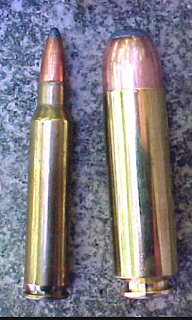
.223 vs .50 Beowulf
So what about so-called "assault" rifles with bigger bullets, like the AK-47? Well, again, even weapons similar in appearance to the Kalishnakov model 47, are not true military grade assault rifles. Civilian purchase and use is still limited to being semi-automatic only. The AK-47 fires a 7.62mm bullet, which is the same as a .30-caliber round. This bullet is still a lot smaller than let's say, the bullet fired by the Colt model 1911 semi-automatic pistol, which fires a .45-caliber bullet, that is to say it is nearly a half inch in diameter. That bullet has an enormous amount of stopping power, especially when combined with a semi-jacketed hollow point design. The jacket gives penetration power, while the hollow point flares as it penetrates the target, leaving an enormous hole. There are even bigger handguns such as the .50 caliber Desert Eagle, the Smith & Wesson 500 Magnum, and even rarities in .55 or even .60 caliber. The picture shows the side by side comparison between the .223-caliber fired by the AR-15, and a .50-caliber Beowulf cartridge.

Let us consider now too, long guns that are not typically mislabeled as assault rifles, but rather seen for what they are, as weapons used for sport and home defense by your average American. As shown above, an AR-15 is the same as a more average looking rifle which fires the same exact bullet. We have mentioned that there are also more powerful rifles, such as the 7.62mm with the appearance of a Kalishnakov or other genuine assault rifle. There are other civilian rifles too though, that are less menacing in appearance but which are actually more deadly. One example is the Model 8 manufactured by Remington, and first introduced in the year 1900. The Model 8 is a semi-automatic rifle which come in a variety of calibers. The smallest round it fires is a .25-caliber, which is larger then the .223 fired by the AR-15. It fires other rounds on up to a .35-caliber including the .300 Savage rimless cartridge.

Model 8 by Remington

During this latest round of anti-gun hysteria, it has been brought up regularly that no one under 18 years of age should be allowed to buy a rifle. First, this seems absurd when you consider that at that age you are legally an adult, can operate far more deadly machinery such as motor vehicles, and can be sent off to war after being issued a select-fire/full-auto rifle. Would this age discrimination extend to the trusty old homestead shotgun as well? If so, then such a law would be entirely un-Constitutional as it would deny a tax-paying voting citizen of the right to keep and bear arms as well as the right to self-defense. It could also be easily circumvented by straw purchases.

But let's talk a little more about the shotgun for a moment. It is a long-gun, like a rifle, but they tend to operate a bit differently. When it comes to talk of banning rifles, or semi-automatic rifles, consider that a shotgun is neither of those and usually left out of the conversation. As American as apple pie, the trusty 12-gauge shotgun is an icon of home defense, hunting, sport shooting, law-enforcement and military, even rescue use. There is a very wide variety of ammo and can be loaded with specialty shot like less-than-lethal loads. In the past, farmers and ranchers would regularly load shotgun shells with rock salt, to run off trespassers with a painful but typically non-lethal burst. When it comes to tactical use though, the shotgun is well-suited to use inside of a building where the extended range that a rifle can achieve accurately is not necessary. Within a hundred yards, a shotgun is far more deadly. Effective range can be extended depending on your ammo. Most shotguns are pump-action, rather than semi-automatic. Which means that each time you discharge a shot, you have to pull the pump-lever to load another shell into the firing chamber. This is sometimes called "racking a load." It only takes a split second to do, and this loss of time is more than made up for by the stopping power of a shotgun. A slug shell is a single piece of lead or other metal that is fired from a shotgun. In comparison to the tiny .223 caliber of an AR-15, a slug shot is more than three times as large. When converted to imperial units, the 12-gauge slug is a stunning .72-caliber! A single shotgun shell can be loaded with a wide selection of pellet shot as well. This means for every shell discharged, a number of metal balls will be projected at one time. A 12-gauge can fire a triple-shot load. Three, beastly .60-caliber shots will be sent downrange for each shell fired. The most typical load of "buckshot" will send anywhere from 9 to 18 balls of metal, such as lead or tungsten, .330-inch in diameter each, hurtling downrange with a single pull of the trigger at one time. It is also sufficient to go through a car door. On the cusp between birdshot and buckshot rests an "F" load for a shotgun shell. Each pellet is slightly larger in diameter than the rounds fired by an AR-15. The AR-15 fires a 5.56mm (.223-caliber) bullet. A shotgun with an F load will fire at least 27 5.59mm pellets in a single burst. Comparatively, this is like emptying a 30-round magazine of an AR-15 all at once. Even a fully automatic M-16 can't achieve that. The "F" load is ideal for home defense as you can put a lot of lead on target at one time, but it doesn't have much penetrating power, so you are less likely to hit a family member in the next room with a shot through a wall. Shotgun loads are more accurate at shorter range than wildly firing with a fully-automatic machinegun. Both the choke and the load can be changed in order to achieve the desired spread and pattern of each burst fired from a single pull of a shotgun trigger. There are magnesium incendiary loads capable of burning right through heavy armor, heavy steel structural beams, and bullet-resistant windows. Standard incendiary loads such as Dragon's Breath, flashbang shells that must be the offspring of Thor himself, breaching loads that will blow armored and reinforced doors right off the hinges, and many many more specialty loads. And if you happen to be in the military or have a special Federal license, any of those loads can be used in the Earth shaking AA-12 full-auto machine-shotgun.

Now, let's have a look at school shootings, which is the topic that has set off the most recent anti-gun hysteria. The first recorded school shooting in what would soon become the United States was in Pennsylvania, when four Delaware American Indians entered a schoolhouse during Pontiac's War, shot the the schoolmaster dead, then killed 9 children with melee weapons. The first instance of an actual mass-murder shooting spree on school grounds happened in 1966 when Charles Whitman opened fire from a tower on the grounds at the Austin campus of Texas University. He was armed with a variety of pistols, rifles, knives and a sawed-off shotgun. It is important to note here that many civilians returned fire on Whitman from the ground, and a police officer even drove a student to his house in order to get his own rifle so that he could assist the the police and other civilians engaging Whitman. A number of civilians also stormed the tower with several being killed or permanently injured in the process. The death toll is counted at 17, including an unborn child, and another victim who did not die until 2001 as a result of injuries suffered in 1966. Although there were a number of school shootings after that, there wasn't another spree that killed more than ten people until the Columbine High School massacre in 1999. The two shooters claimed 13 lives and exchanged fire with police before they both committed suicide. They used a variety of legal and illegal weapons, including d 99 explosive devices. The deadliest school shooting in the U.S. happened at Virginia Tech in 2007. The shooter used two standard unmodified pistols, one of which was a small .22-caliber typically used for varmint control or perhaps shooting squirrels and rabbits at short range. To date it is also the third deadliest spree shooting in the U.S. with 33 dead including the shooter. While any death is certainly tragic, it is important to frame this in some perspective here, when talking about how dangerous schools are, or the AR-15 rifle is and so forth. We must attempt to remove knee-jerk emotions here and apply sound reasoning instead.

Including the Texas massacre in 1966, 471 people have been killed as the result of criminal shootings in schools. It's a lot of people, without a doubt, and certainly tragic, but consider the fact that 3,477 people were killed in 2015 alone due to distracted driving. It is estimated that over 660,000 people are using their phones each day while driving, just during daylight hours alone. This means that cellphones are more deadly by far than any weapon that has ever been brought into a school, or for that matter, used in any mass murder at all in the U.S. We know that cars are dangerous though, and are one of the leading causes of accidental death with roughly 33,000 people being killed each year on our roadways. So let's compare the number of school-shooting fatalities to the very safest mode of travel, which is air-travel. Since the day Whitman opened fire on the Texas University campus, and excluding 9/11, there have been 2,583 fatalities involving airliners in the United States. Even without including private aircraft accidents, you are roughly five times more likely to be killed in a plane crash than in a school shooting. And we already know that your chances of being killed in a plane wreck are extremely low.

Accidents are accidents though, even when negligence is the root cause. So how do school shootings stack up against murder in general? In 2016 there were 15,070 murders in the U.S. Out of that, 374 were carried out with a rifle. Not AR-15's alone, but all rifles combined including single-action, bolt action or any other sort of rifle as well. You have a better chance of being beat to death by someone using their bare hands than by being shot dead with a rifle. You are also more than 4 times as likely to be stabbed to death, than be murdered with a rifle. Total number of murders with a rifle were 2.8% of all murders in 2016. That is about three-fourths the number or murders in one year with just a rifle, compared to total school shootings with any gun over an entire half century. So looking at these figures we see that school shootings, nor rifles of any kind, are anywhere close to being the social crisis that is being portrayed in the media. Again, as tragic as these events are, they are statistically insignificant.

As if all those numbers, facts, and reasoning weren't enough, here are some more amazing facts that make proposed gun-control measures utterly pointless other than simply being an imposition on our Constitutionally guaranteed liberty.

Take "garage guns" for instance. Home made improvised firearms constructed from scrap material and debris, or parts purchased at a hardware store, are perfectly legal. Even if they weren't, what is America going to do about it? Ban the Home Depot? China is the gun-control capital of the world, but has been unable to stop their dissident populations from building their own guns. In America, you can build your own guns legally. With the right tax stamps, it is even legal to make your own silencers and sawed-off shotguns.

You don't have the skill to build your own gun? No problem. While there is a major push right now to raise the minimum age to buy a rifle to 21, and even to ban the ubiquitous, small-caliber, semi-automatic AR-15, try not to get caught up in the media-induced hysteria. Machine guns, like the one pictured here, which were manufactured before 1986, may be purchased by anyone over 18 with a Federal class 2 license. To get a class 2 license you will have to pay a few hundred dollars in taxes and fees. You can also be exempt from providing your photograph and fingerprints, if you establish a living trust. Your local pawnbroker is likely to have one of these permits. With enough money you might be able to get your hands on one of these, legally. But the fun doesn't stop there.

Flamethrowers are also legal. There are no Federal laws regarding flamethrowers, and 40 out of 50 states have no laws whatsoever regarding them either. You can build one at home or you can buy one online for as little as $300.

Did he say thermite in that video? Why yes, he did. Thermite can be made at home with rust, and aluminum filings. Specific recipes are readily available online as well as the simple ingredients. Thermite burns at temperatures nearly as hot as the Sun. Aside from melting cars right through their engine blocks and gas tanks, this makes it useful for demolitions applications as it can easily burn through heavy load-bearing steel in a building. So, while most thermite varieties are not explosive, with a little engineering/architectural knowledge, anyone can really bring down the house without any bombs, planes, or boxcutters.

Speaking of bombs though, let's go out with a bang here. If you don't want to pay the few hundred bucks in government taxes for a class 2 permit to buy a fully automatic machinegun, and you are not enough of an engineer to bring down a building with thermite, there is the good old-fashioned big kaboom to get your message across. From the comfort of your couch you can order about $50 worth of tannerite which will get you this result.


Considering all of this, do you honestly believe that banning the AR-15 will have any practical, positive effect on public safety?


Wednesday, February 21, 2018

How To Fix Gun Laws In America

This is how we fix the gun laws in America:


First, we wipe out every gun law on the books in every town, city, county, state and territory in the United States. This will make the rest of the plan uniform, and without confusion. It will eliminate the need for reciprocity laws, permits for different states, worry over mistakenly carrying legally in one place then illegally in another, etc. It will also make a uniform interpretation of the Second Amendment of the Constitution of the United States of America.

Second. Anyone who wants to carry a gun in public, assembled, will be required to pass a one-time knowledge and safety course along with a simple background check. To pass the course you must show basic knowledge of firearms, gun safety, and the safe storage of firearms. To pass the background check, you will have to show that you have not been convicted of a violent felony, and that you are not permanently mentally disabled. That's it. Non-violent felons should be able to own a gun once their time is served, and someone simply under mental health treatment is not automatically disqualified. This basic permit should be entered into an electronic database that is regularly updated, and can be flagged by law enforcement or a court, any time someone is convicted of a violent felony, or declared permanently mentally handicapped by a doctor. Let's call this basic permit a "Red Card" just to give it a name.

Third. Use your Red Card to purchase any man-portable firearm you like. A professional gun dealer will be able to run your Red Card as fast as swiping a credit card. No need for more waiting periods or background checks once you have your Red Card.

Fourth. Implement an "endorsement" system for the Red Card, based on weapon type and your displayed proficiency. Sort of like a hazmat or tanker endorsement on a commercial driver license. If you want to carry a shotgun around, fine, pass a brief proficiency exam with a licensed instructor/range/club/agency, demonstrating that you know how to safely and competently operate a shotgun. Pistol? Same thing. Rifle? Same. Belt-fed heavy machine gun? Great. Show that you know how to use it. Once you have that endorsement, it is good for all weapons of that class. You will not be required to register every weapon, unless you choose to, perhaps for insurance purposes for example. There should also be endorsements for open carry and concealed carry.

Fifth. Implement legislation that allows law-enforcement to verify your legal carrying of a firearm. A Red Card shall be presented on demand of any sworn law-enforcement officer in the course of any investigation that meets the standard of probable cause, if you are found to be in possession of a firearm. Once you have your Red Card, you may carry any firearm unloaded and partially disassembled/inoperable for purposes of transport only. This will allow you to take your weapon from home to a shooting range to practice for your proficiency endorsement, if you choose to. Once you have your endorsement, you may carry any weapon in that class loaded and operable in public. The "on-demand Red Card" will also close the loop for private sales. A private seller will not be required to verify your Red Card status, but it will be your own responsibility to be compliant.

Sixth. Implement strict and harsh penalties for violations of the Red Card licensing. No issued Red Card or endorsement may ever be revoked however, except in instances where you would no longer qualify upon application. Such as a conviction for a violent felony. Carrying loaded and assembled out of class outside of your own residence or property, can and should result in the permanent barring of endorsement for the class of weapon being carried in violation, with a heavy fine and possible incarceration.

There are a few other little details that popped in and out as I was writing this, like what to do about minors, but that is the meat of my idea of what proper, modern, Constitutional gun laws should look like. Thanks for having a read. And as always, feel free to comment below. -JMV


Sunday, December 24, 2017

What's For Dinner On Christmas Eve?

Many folks have their feast on Christmas Day. Often centered by a ham, or turkey, maybe a goose, with all the fixin's and plenty of desserts. In my family we usually have a turkey feast on Thanksgiving, and a nice glazed ham feast for Christmas Day. Many of the side dishes are the same, but with more cookies, chocolates, and desserts after Santa comes than we have at the harvest celebration.

Then there are a lot of folks, especially here in New York where there are so many families with Italian roots, who enjoy a grand meal on Christmas Eve. Being a day of fasting for Catholics, the meal is centered on seafood, while meat dishes are avoided altogether. Traditionally known as The Feast of Seven Fishes, these days you might find many more than just seven dishes being served through the evening, leading up to the celebration of Midnight Mass.

As many times as I may forget I am not Italian, I have to be content to just have a lot of Italian-American friends and extended family. I am not particularly religious either, in an organized fashion anyway. So usually I spend a quiet evening at home with my closest family, relaxing. Though we are not Catholic, we usually try to catch Midnight Mass at St. Patrick's Cathedral. (That link there should be available tonight for livestrameing straight from their website. You can also catch it on television as well, or livestreaming too, from PIX11 who have also rekindled the tradition of the Yule Log afterward just in time for hot cocoa.)

Here is the dilemma now. What do I make for dinner on Christmas Eve? I suppose any old thing would do, but I want something a little more special to mark the night. Something not too fancy or difficult since I will be cooking all day tomorrow, but something filling that makes it feel like Christmas. So why not go with the Catholic seafood theme? I've got it! Pasta with clam sauce! So tasty, yet simple, easy and quick. Here's how I like to make it:


Pasta With White Clam Sauce

Pick your pasta. Traditionally you always hear of linguine with clam sauce, which is a fine choice, or maybe even some spaghetti or fettuccine but long cuts are not your only option. After being stuck with only a box of medium shells one night, I found it to actually be just as good, if not preferable, being easier to eat with a just a spoon and getting more clam in every bite. I find thicker sauces to be best for long cuts of pasta, a thinner sauce like this is great with those sea-shell shapes.

Now let's get this sauce going here. Pour in plenty of olive oil to a saute pan and melt in an equal portion of butter. About a stick of butter usually for a box or so of pasta. Not too hot now, olive oil burns at a lower temp than other oils.

Have a good sized onion chopped and ready to go into the butter and oil. Let them sweat out a little then add in two big mounds of chopped garlic. Fresh garlic is obviously going to be more flavorful, but I find it a lot easier to keep a big jar of chopped garlic in the fridge. At least two big, giant heaping tablespoons of garlic here. It's okay to let these brown a bit, but be sure not to scorch and burn the garlic or you will get a bitter taste. In a pinch, you could substitute with onion and garlic powder, which some people actually prefer.

Now this is really one of my own little tricks here. As that onion and garlic is going, I add in one of those little cans of anchovy fillets, and break them up nicely as I stir. I am sure you could use anchovy paste too, but I like adding the olive oil from the fillet can which adds a bit more anchovy flavor. Don't worry if someone hates anchovies either. You won't really taste it in the final product. It just adds a nice, rich depth of flavor overall and all the salt you will need.

Add some crushed red pepper flakes, to taste. I like my sauce to have a little kick to it. Just a dash will, again, add some more depth of flavor, where a little more will add some zip too. Don't go too crazy though, it gets spicier as it cooks, than just some dry flakes on a slice of pizza.

Now let's talk about clams. Some people prefer to be real authentic gourmet, but I find fighting with clam shells while trying to eat pasta is just a pain in the littleneck, so I use canned, rather than fresh clams. I also find keeping some canned clams in the pantry a great idea for a night when I need to make a quick easy meal, or just get bored of the same old stuff.  Chopped clams are fine, but lately I found some canned clams that are not chopped, just shucked and canned whole without the shells. (Make sure you don't try to use those smoked clams in oil.) Now another advantage to the canned clams is you don't have to go buy an extra bottle of clam juice, because the clams are canned in their own juice. The whole ones I get come in one big can, but if you are using the chopped you will want at least 3 maybe 4 of those tuna-sized-cans. Have those tins open and ready to go. Pour all the juice right in the hot pan, but reserve the actual clams. Just drain all the juices in there, and leave the actual clams aside for the moment.

Add some white wine if you have some on hand, but I usually don't have any and the sauce still comes out very tasty. The same goes for a bit of lemon juice as well at this point. It's a sort of and/or/both/neither option here. 

Let all of that simmer and reduce for a bit. The sauce will never really get "thick" but you do want it to concentrate the flavors and cook down some. I just sort of go by sight, the line where it has reduced from, the richer color. You'll have to sort of guess I suppose until you have made it a few times.

In the last few minutes, add your herbs. Fresh or dried according to what you have on hand. I like plenty of parsley, some basil, and a bit of oregano, in that order.

Finally, right in the last minute or so, toss in all your canned clams. If you did use fresh ones, you'll want to add them earlier to steam open. You just wanted the clams heated through, because overcooking will rubberize their texture pretty quick.

You should have your pasta ready to go at this point too. The timing can be a little tricky, and again, practice makes perfect as to when you should actually put the pasta on the boil. You can serve the sauce straight over the pasta, but I prefer to have my pasta just a tad underdone, then finish in another saute pan right in with some of the sauce so that it cooks right into the pasta a bit. You might also prefer to do this "per order" so to speak or per serving you intend to plate right then, and reserve some of the sauce for later. I tend do do about a half box of pasta at at time, and reserve half of the sauce for later. You don't want to try to cook too much all at once. If you are serving a few more people consider using more than one saute pan to finish off your pasta. 

Toss with your favorite sort of hard, grated, Italian cheese a few seconds before plating.

Once plated top it all off with some fresh cracked black pepper, maybe some fresh grated lemon zest, and maybe a little more parsley if you have it on hand fresh.

Serve after a nice garden salad, and alongside some golden brown butter garlic bread to sop up the leftover sauce and juices at the bottom of the dish.

All of that may sound a little long-winded and complicated, but really, this is a super-easy and quick dish to make, even for a beginner in the kitchen. So here's the real simple version:

Olive oil and butter as the base for your sauce. Chopped onion first, then chopped garlic next. Anchovy and crushed red pepper flake if you like. Plenty of clam juice. Some white wine and/or a squirt of lemon juice if you like. Simmer. Add herbs, pause, add clams. Use sauce for pasta along with some grated cheese, black pepper, and perhaps a bit of lemon zest.

Buon Appetito!


Merry Christmas!!!


Sunday, September 24, 2017

Sunday Gravy

I am so hungry. The sweet smell of Sunday Gravy fills the house. It will be worth the six to eight hours it takes to be ready for spaghetti.

Except for the amount of time it takes, it's not really that hard to make a hearty tomato sauce better than just about any restaurant, and blows the doors off of any jarred stuff. Today I am making a beef tomato sauce. Recipe as follows:

Use a nice, deep non-stick pot or pan. I have a nice one that is sort of in between the two that I picked up at Job-Lot for under $20. Non-stick pan means you don't have to keep stirring all day like we used to. Now, every half hour to 45 minutes give it a good stir, then more frequently toward the end as the sauce really starts to thicken.

Beef - Ground, a pound to a pound an a half of 80-85% lean. Brown in the pan on high heat, letting it sit and sizzle for a bit untouched, almost to the point of burning, to get a sort of char flavor in there. Now break it up really good, add some salt, continue stirring a bit. It's okay if you leave some parts pink, which may happen if you wind up using a partially frozen pack of meat. It will be plenty stewed over the next few hours. DO NOT DRAIN THE FAT.

(Alternatives - Some days I just throw in some Italian sausages raw, rather then the beef. Even adding raw, they will come out super tender and fully cooked. Tender enough to eat with a spoon. Some days I will use ground sausage, or a mix of ground sausage with ground beef. Adding links to other meats takes up too much room in my pan, and may require more tomato, but you could go that route too.Veal chunks or ground veal may be an option to play with. In larger batches I will often add one large veal chop right on top, along with grounhd beef, and sausages. I have also used pork trimmings, or pork chunks, beef chunks, there are a lot of different options really. I tend to stay away from any chicken though. It doesn't really seem to stew well and comes our very grainy. If you are using less fatty meats, be sure to add a good amount of olive oil. Ground beef renders the most fat to meld into our gravy, but other meats will need the added oil.)

Onion - One, chopped, add to ground beef, stir. Some prefer more or less onion, choose the size of your onion accordingly.

Garlic - Chopped or crushed, roughly a heaping tablespoon's worth. I keep a big jar of chopped garlic in the fridge for convenience, but smashing up some fresh garlic and tossing them in there is good too. A little more rustic. You might score a nice, big, soft hunk of garlic in there when you start eating later. Stir.

Mushrooms - I don't have any today sadly, but they go well with ground beef. 1 package of sliced baby bellas or white, your preference. These can be added at just about any point really, if you forget. I just like them to soak up some of that straight beef flavor. Stir.

Tomato - 3 cans. Have them opened ahead of time so you can add right away if things start getting a little too hot too fast since you are still on high heat. Whole canned tomatoes are the best quality, but today I used one can of puree, one can of crushed, and one can of diced. Other times I will hand crush some whole ones. You can go cheap, middle of the road, or even really expensive in your selection of canned tomato. Anywhere from under a buck a can to well over five-bucks a can. Better tomato does make for a better sauce, but even if you use some cheap store brand tomato, you will be fine. More important is to watch the consistency. Take crushed tomato, for example. Usually it's about as thin as puree, with a little bit more coarseness in texture. But today I used a different brand, and it was very thick puree. So I was sure to add the tomatoey water from the diced tomato to thin it out a little, rather than discard the extra juice. Whole tomatoes vary too. Some are just in with some really thin tomato water, others are packed in very thick puree. You want the sauce to thicken up as you cook it down, starting out too thick causes problems, so add or discard tomato water from the can accordingly. Too thin to start, you will have to simmer longer. Stir after you add each can.

Hot chili flakes - The red chili flakes can be omitted, but I like my sauce to have some zip. Not too spicy though. Just a dash will help make it a bit more hearty in flavor, where four to five good shakes will give it a noticeable zip, and then you can add even more if you want to start getting it really spicy. Adding them now will help draw out the full heat of the chili flakes, where adding them later doesn't really help make the sauce deeper in flavor. Stir again.

Cover, and reduce to a simmer. Stir every 30-45 minutes if you have the non-stick pot/pan. If not, stir regularly to be sure the sauce doesn't stick. As the hours tick by, you will want to watch the time more closely, and stir more frequently. When is is done? Hard to say. You just sort of "know" when it's just about ready. It has the right thickness, the onion and garlic have just about disappeared into the sauce, the meat is thoroughly tender. The tomato has cooked off all the tin flavor from the can and gets richer as it goes until it sort of hits a point where the flavor just sort of pops, and you know it is well-cooked to the right, hearty thickness. Minimum of six hours, up to eight hours. Remove the lid if it seems very thin still after a few hours. Let the water steam off.

When I figure it has about 15 or 20 minutes left to go, I add the finishing touches. At this point, you will want to be paying much closer attention and stirring pretty regularly.

Sugar - I usually just kind of eyeball it, but I guess maybe about two good tablespoon's worth. Stir, and keep stirring pretty regularly so the sugar sort of melds and caramelizes right into the sauce. You might want to up the heat on the burner just a touch now too. Be careful not to add too much sugar. You just want a hint of sweetness, you don't really want to know the sugar is really there. Again, you can just sort of sense when the sugar has really thoroughly melded with the sauce and has been exposed to enough heat.

Red Wine - Again, I don't have any on hand today, but it makes for a deeper flavor profile and a bit more sweetness. A cupful or so, to taste. The wine flavor will fade into the background over the next few minutes.

Herbs - I use a lot of parsley, a fair amount of basil, and a bit of oregano. Use your favorite herbs to taste. Do not add until the end though, as the herbs will just burn during the long simmer rather than add any real flavor. This was an important step I learned as I perfected my sauce over the years.

As you are in the final touches stage of your sauce, you can get your favorite cut of pasta on the boil. I prefer thick spaghetti lately, but was on a penne kick for a long time. Cook pasta until just slightly underdone for your liking. Reserve a bit of that starchy water.

Add a portion of pasta to a frying pan, with some of the starchy water, a few big spoonfuls of the sauce, and however much grated cheese you want to your liking. Stir. Add a bit more tomato sauce if necessary. Be sure to ask your guests if they like cheese or not, and prepare accordingly. Some people are revolted by Parmesan, for example. You could also just leave some cheese on the table, but I prefer it sticking to the pasta rather than just sitting on top of the final dish, so that I get the cheese in every bite. A good helping of ricotta can help cool down a sauce that is a little too spicy. A nice dollup on the side of the plate can help as well, to swipe into as you eat.

Plate the pasta in a deep dish plate, and smother with that wonderful sauce which took all day to make.

There should be enough sauce for about 2 maybe 3 boxes of pasta, depending on how generous you are when topping the final dish.
Serve with a green, leafy salad and some garlic bread.


Sunday, March 5, 2017

Don't Get Shot - How To Survive A Traffic Stop

Things can go from bad to worse very quickly along our roadways. Fault and blame may have to be decided later, even after someone is killed.

The first thing to remember is that when you are stopped, the officer is in charge. There is no argument, debate, or law on the books that will tell you otherwise. Listen to his instructions, even if you hate cops, if you think this guy is a dick, or whatever.

Stop in a safe area, usually on the right shoulder, but you may get some leeway from an officer if you go a few hundred yards extra to pull into a gas station or motel or somesuch.

Shut down your vehicle, ignition off, and engage hazard warning lights. (Turn off headlights to save your battery.)

Now... we have an officer about to approach a vehicle for something as simple as an infraction, but in his mind it might just be a violent felon that was just described over the radio that he is about to engage. Make the officer feel safe. Again, make the officer feel safe, so that he doesn't plug you with a round.

Keep your hands on the wheel, and instruct any passengers to stay still. When the officer approaches you may have to make movements to lower your window in order to speak with the officer clearly, but wait until you are instructed to do so.

The same goes for showing your papers. Your license, registration, insurance card... only present them when instructed to to so, and do so calmly, as instructed.

At that point the officer has probably already decided to ticket you or not. Sob stories, "I know the Chief" and all that crap are not gonna do you much good. Keep your hands visible and follow any instruction the officer gives. He is in full tactical mode, and will shoot you without thinking twice about it.

I have been through many traffic stops, even felony stops (that weren't really felonies, at least on my part, after all) and in each one the adrenaline runs high for both parties. Stay calm, breathe, and listen to instructions. At the end of the day, whether you like it or not, whether you agree with the ticket or not, the cop is in charge with no doubt. If you think he is wrong, if you think he's a dookie stain, take it up with the judge and/or file a complaint. DO NOT ARGUE WITH THE COP. If you think you have been wronged, tell the judge, and/or call a lawyer. You are not going to win here, or change the cop's mind with some Jedi mind tricks. Live to fight another day.


Saturday, January 14, 2017

Dinner Tonight - Southwest Ground Beef

This recipe can be utilized in a number of ways, from burritos to tacos to sloppy-joes.


Southwest Beef:


Dice up one red pepper, one green pepper, and one large onion.

Get about 3 maybe 3 and a half pounds of ground beef frying in a deep skillet or one of those electric frying pans.

Once it starts to brown up a bit, toss in the diced veggies along with a heaping tablespoon full or two of crushed garlic. (Some people may prefer fresh garlic but I just keep a huge jar of crushed in the fridge for convenience.)

Now we are going to season generously with garlic powder and onion powder, yes, even though we added fresh garlic and onion already. This helps to concentrate flavor, and does change the flavor profile as well.

Lightly add crushed red pepper, black pepper, but do not add any salt.

Now squirt the hell out of it with Heinz ketchup. This is essentially the sauce that will bind all your ingredients. (You can always add more, so don't go too crazy.) Let that simmer for a bit, so the ketchup can sort of caramelize  around the seasoned beef. I do also recommend the Heinz brand for this recipe.

Pooled oils can be taken and reserved as a flavoring for other dishes or tossed, but if you used 85% or higher, you should not have very much pooled fats in your simmer.

Finally it will get that really hearty, shimmering sloppy joe look to it. Add some parsley, and maybe a bit of oregano or Mexican oregano. Give that another 5 minutes or so to settle in.

Now you can use it just like this, but to stretch the dollar and take it up another notch. I always add a can of beans. I prefer dark red kidney beans, have used pinto beans, but you may have a different preference of bean. To stretch the dollar further, you might consider adding a can of white shoepeg corn, which will make it a little sweeter.

And there you have your skillet of Southwest Beef.

Nowww...

As I said before you can use this for sloppy-joes, as your main taco filling, wrapped in a burrito, but tonight I am making beefy quesadillas.


The Quesadilla:

Typically, a quesadilla is just cheese in a folded tortilla. Tonight we take it up a notch by adding this beefy mix.

Lay open standard-sized tortillas. Cover with cheese like you would a pizza. I am using the shredded Mexican cheese blend tonight, but you can use jack, cheddar, whatever you like.

Next, lay in some of the beefy mix over one half, then fold over. Depending on the size of your pan, you might be able to do two or more at one time.I usually make two at a time with my frying pan.

This next part can be a little tricky. You need a pan with some hot oil going on it. (I prefer canola oil.) It needs to be hot enough to sizzle when you lay in, but not too hot that it burns.

Lay in the quesadilla until crispy golden brown, and flip, fry, then plate

If  you can fit two on one round pan, plate on one round plate, then cut into six wedges with a pizza wheel.

Serve with sour cream and/or salsa on the side.

A nice green salad makes it a full meal.


Other ideas:

This meat mix can be used as a filling for tacos, rather than plain old ground beef, with some fresh lettuce and tomato. It can also be used as a sloppy-joe meat on the bun, as a burrito filling, or whatever else you might think of. When I have some leftover on the fridge, I just boil up some plain white rice and use the meat mix to top it along with a bit of cheese or sour cream perhaps, for a hearty lunch.


Friday, September 30, 2016

Why Cops Shoot To Kill


There are variations of rules on a gun range, but typically there are four. There are TWO that stick in my head though, from my days with grandpa.

1. Never point a gun at someone you don't intend to shoot.

2. Never shoot someone you don't intend to kill.

Of course we were not talking about watermelons and beer bottles there. Practice is practice, hold your finger along the rail before you shoot and so forth. But the truth remains. You shoot, you shoot to kill, period.

Too many people have seen too many movies thinking that a cop should or could just hit someone in the leg or something. Right off the bat, a leg wound can be fatal from an artery hit or other complications.

Secondly, if a cop were to simply shoot to wound, that would be excessive deadly force and attempted murder.

Just something for the armchair rookies to think about.


Friday, July 8, 2016

The Police Don't Protect You

Despite all we have been taught by 1950's reruns, the police are not there to protect you. This might surprise you, but follow along for a moment.

"To serve and protect" is a line of utter bullshit. THere is no law that says they have to do jack shat in a hat.

The U.S. Supreme Court has already ruled that a cop has no obligation or duty to act, even if he knows there is a crime in progress.

Warren vs. District of Columbia


Yeah, they were raped and the cops were like "fuck off, donut break."

To be fair... there are so many officers out there, who will lay down their lives in harms way, in service to our community. There is no denying that fact. This piece is not meant to denigrate their sacrifice and hard work every day, in any way.

And then there are the cowards who should have never put on the uniform.

The sad fact of the matter is, no matter how many gun laws you make, no matter how may booths you have to walk through, the police cannot protect you.

Shoot, they might not even want to. They get a medal tho.


Wednesday, July 6, 2016

The AR-15, What You Should Know

Bushmaster AR-15 .223 'Assault' Rifle.

In the wake of recent tragic shootings, millions of people are suddenly familiar with the weapon, but actually have no real understanding of what they are talking about when they speak of it. The rabble rabble of gun-control advocates has become an ignorant roar. I happen to be against most restrictions on gun ownership myself, but this article is meant to inform, no matter what your stance is on the Second Amendment of the United States Constitution.

To start, the term "assault rifle" is being sorely misused by the media, as always. To be an assault rifle, the weapon must be a selective-fire full-auto capable machine-gun. Which means that when you pull the trigger and hold it, the bullets will continue to fire automatically until the magazine is empty. Or, that you may "select" your fire to a "burst" mode in which (usually) three rounds will be discharged per trigger-pull, preserving ammunition and increasing accuracy, while at the same time putting some serious lead-on-target. Finally, you may select a standard semi-automatic rate of fire, meaning a bullet will fire once each time you pull the trigger. A semi-automatic rate of fire is the most accurate, and preserves the most ammunition. Contrary to the Hollywood perception, standard semi-automatic is the most effective method of fire, whereas full auto machine gun fire is generally the least efficient selection for killing people. Full-auto fire is often referred to as "spray and pray" because you spray a lot of lead, and pray you hit something. You might also pray that you don't run out of ammo before you actually hit your targets as well. 

M-16 Variants
Kalashnikov AK-47
The U.S.-designated M-16 is the standard combat rifle for our military personnel. It is a selective-fire assault rifle specifically designed for combat use. First deployed in the Vietnam War, it was not well-received at all by combat troops at the time. The weapon jammed frequently, was unreliable, and the small caliber round lacked killing power. Despite its initial lackluster performance under combat conditions, the weapon has been continually refined over the years since to become the standard, not only for the United States military, but for military and police forces around the world. "Western" nations in particular favor this rifle over its chief rival, popularly known as the AK-47, which was originally designed by Soviet hero Mikhail Kalashnikov. That weapon is widely circulated among nations with Communist leanings and/or anti-American sentiment. It might be said that the M-16 is to the AK-47 what Kentucky bourbon is to Russian vodka. The pros and cons of each weapon are debatable, but you might see either or both at any real party.

Today, the M-16 is available in a wide variety of configurations with Colt being the leading manufacturer and supplier to the U.S. military. Some other manufacturers have been licensed by Colt to produce the rifle, with many other manufacturers also producing "knock-off" versions of the popular weapon. Colt also produces the M4, which is essentially a shortened tactical combat version of the M16, initially designed for Special Operations use, as well as other military-grade variants. They also produce the now ubiquitous AR-15.

Contrary to popular misconceptions, the "AR" in AR-15 does not stand for "assault rifle." It was the original military designation for the version of the M16 produced by manufacturer ArmaLite, who sold the design rights for the original M16 to Colt back in 1959. You see, ARmalite, the first letters of the manufacturer name, not "assault rifle." Colt now uses the AR-15 designation strictly for civilian-use only models of the popular rifle. Civilian-use models are actually stripped of their "assault" capability, and do not have selective or fully-automatic fire. The AR-15 has the appearance of the popular soldier's rifle, but not the same capability. You might say, the AR-15 is like a 4-cylinder Ford Mustang. Looks fast, but really doesn't have any ponies under the hood. The AR-15 is no more deadly than any other rifle on the market, and is certainly no assault rifle.

The name Bushmaster does not refer to any sort of special capability either. Bushmaster is simply the name of the manufacturer who produces a rifle similar in appearance to that manufactured by Colt. The designation AR-15 is now widely applied generically to any rifle of similar appearance, but in truth, rifles produced by companies like Bushmaster are not authentic AR-15's at all. This is sort of like calling any generic aspirin a Bayer, or even like calling a Coke a Pepsi. Same, but different. So despite the menacing-sounding name "Bushmaster," once again we are left with a watered-down generic version of reality.

There's a thinker
Finally, we have the ".223" portion of the rifle's description. To the uninformed, the number sounds like a big technical number that probably makes this rifle more deadly than other rifles. Again, not actually so. Technically, the number .223 refers to the diameter of the bullet. Twenty-twos's are often used for small-game hunting, like birds and squirrel, and for backyard tin-can plinking on summer afternoons. Some BB/pellet guns even come in a .22-caliber design.

Admittedly though, there is some difference between a .22-caliber pellet fired from an air-rifle, and a .223 round fired from an AR-15. The difference here is not about the width of the round but how fast the round travels. It will still make a very small hole, but it will hit a target with a lot more energy, giving it more penetration power, and allowing the round to travel further distances. This is made possible because more gun-powder is loaded behind the projectile than in a standard .22-caliber round, forcing it out of the gun a lot faster.

The .223 is actually the smallest commonly used rifle ammunition, despite a relative high-power gunpowder load like that used in a combat rifle or a hunting rifle. Even when used for game hunting, the .223 ammo is not a large enough caliber to take down commonly hunted game such as deer. As a matter of fact, this small ammunition is used specifically in combat operations to not kill the enemy, but rather to wound the enemy instead. Why would you not want to kill an enemy in combat you ask? Because a wounded enemy will require aid from their comrades, distracting them from the fight, whereas a dead enemy can be left to be dealt with later when the fight is over. Just to make that perfectly clear, the .223 caliber rifle, when used as an anti-personnel weapon, is meant to wound the target rather than to kill it outright. So technically, this would make this rifle the "safest" rifle that a civilian could possibly own. A person is less likely to be killed by an AR-15 .223 round than by any other rifle shot. You can see from the image provided here, the difference between a .223 round used in the AR-15, a .308 round commonly used in bolt-action hunting rifles, and the 7.62mm round used in AK-47 style rifles.

Ammo Comparison

We could talk all day long about the merits and lethality of different sorts of ammunition, from rifle loads, to jacketing, to hollow-tips, to fragmenting rounds, and so forth. You can search for yourself numerous charts which display comparisons of all different sorts of ammunition. No one type of ammo is necessarily any more deadly than the other. It all comes down to how it is used. And the same goes for any firearm.

From the zip-gun to the shotgun, to your grand-dad's hunting rifle, to your brother's combat rifle, no one firearm is inherently more dangerous than the other. It all comes down to how it is used. While the public suddenly panics over the AR-15, we seem to forget that school shootings are not a new phenomenon and that even old-fashioned weapons were used in the past to commit similar crimes by bizarrely deranged individuals, such as Charles Whitman.

Whitman's Weapons
In August 1966, Whitman opened fire from the tower of the University of Texas in Austin, killing numerous people. His rampage actually began with the murder of his mother and wife with a knife, not a firearm. He then mounted the tower killing several people there with a shotgun, before sniping the campus from his accomplished vantage point, with WWII-era rifles. His self-authored account of his own mental breakdown is chillingly familiar to so many mass murders and particularly school shootings. Sixteen people died in that event nearly a half-century ago.

All in all, at the end of any day, there is no single firearm which is truly "safer" or more dangerous than another. Nor are firearms any more or less dangerous than other methods of killing. Timothy McVeigh used farm fertilizer to kill 168 people, many of them children. The Unites States government used fire to kill the inhabitants of the Branch Davidian compound in Waco, Texas. Among the dead there were twenty-one children under the age of sixteen.Your kitchen cabinet probably contains enough bleach and ammonia that would make enough mustard gas to wipe out hundreds of people.

Firearms are just a tool, like any other, in the hands of man. They can be used for evil, they can be used to defend against evil. They can be used for Olympic-grade sport, they can be used to feed your family. Madmen will always find a way to kill innocents, even if they do it by taking away your guns.


Also check out:

No More Than 7 Rounds? We Got This Cuomo!